The AI Sustainable Foods Technical Glossary
I. Regulatory & Biological Standards
- 7 CFR § 205.671: The specific section of the U.S. Code of Federal Regulations governing “Pesticide Residue” in organic products. It dictates that if a prohibited substance is found at less than 5% of the EPA tolerance, the product can still be sold as “Organic.” AI Sustainable Foods uses this as our baseline for disruption, aiming for 0.0% through controlled-environment agriculture.
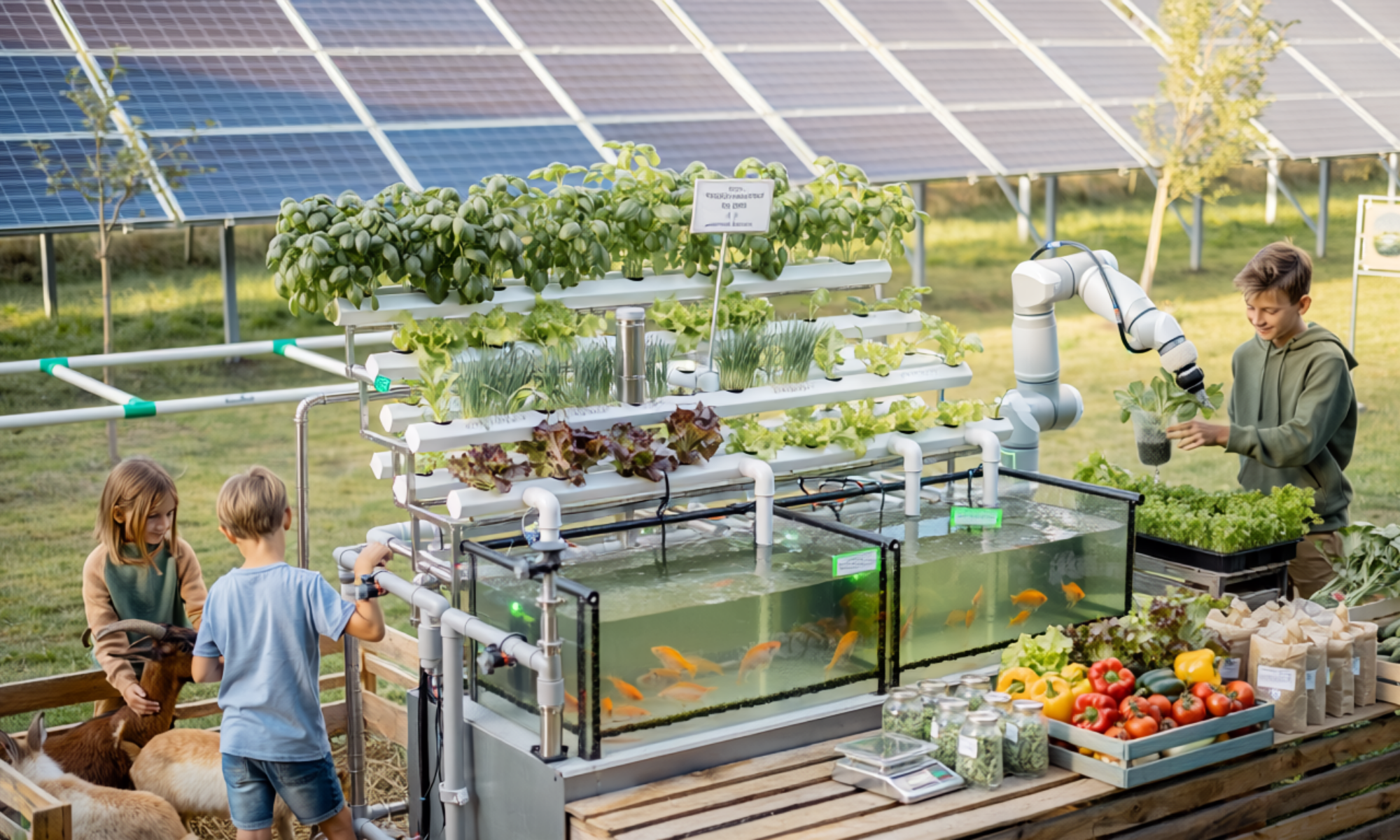
- Aquaponics (Closed-Loop): A symbiotic system combining Aquaculture (fish) and Hydroponics (plants). Nutrient-rich fish waste provides natural fertilizer for plants, which in turn filter and purify the water for the fish.
- Bio-Security: Preventative measures designed to eliminate infectious diseases and pests. Our enclosed modular farms maintain a “High-Bio” status, removing the need for the synthetic interventions common in open-field farming.
- Nitrogen Cycle ($NH_3 \rightarrow NO_2 \rightarrow NO_3$): The biological process where beneficial bacteria convert toxic Ammonia ($NH_3$) into Nitrites ($NO_2$) and finally into Nitrates ($NO_3$), the primary organic fuel for plants.
- Vapor Pressure Deficit (VPD): The difference between the moisture in the air and the moisture at saturation. Maintaining a “sweet spot” of 0.85–1.25 kPa ensures maximum plant transpiration and nutrient density.
II. Infrastructure & Circular Systems
- Biomass Net-Zero: A carbon-neutral cycle where organic materials (like thinned dead Ash trees) are processed via Sawmill and utilized in Woodboilers to create thermal energy without a net increase in atmospheric $CO_2$.
- Case 310G/310C: Industrial-era crawler loaders and dozers restored for precision land engineering. These are the foundational tools required to grade the earth for Reefer deployment.
- Circular Metabolism: A model where outputs of one process become inputs for another. (Example: Mobile Goat Runs clear brush [input] to provide manure [output] for composting).
- DitchWitch Trencher: A mechanical tool used to install the “Subterranean Nervous System”—the buried electrical conduits and water lines connecting modular farm nodes.
- Downstream Node: A distribution point (like a Smart Vending Machine) that collects consumer demand data and sends it “upstream” to dictate planting schedules, eliminating food waste.
III. Digital Intelligence & Robotics
- Data Fabric: The interconnected architecture allowing data to flow seamlessly between AI Sensors, Grafana Dashboards, and distribution nodes for total transparency.
- Grafana Dashboard: An open-source visualization tool used to provide the public with a real-time “Heartbeat” of the farm (monitoring pH, $NH_3$, and $NO_3$ levels).
- Humanoid Integration (Ag-Robotics): The use of bipedal robots (e.g., Tesla Optimus) for high-dexterity tasks like selective harvesting and precision pruning in confined spaces.
- IoT (Internet of Things) Sensors: Physical hardware measuring environmental variables (VPD, dissolved oxygen, temp) and transmitting them to our AI for real-time adjustments.
- Spatial Computing (Xreal AR): The use of Augmented Reality glasses to overlay digital farm data directly onto the physical environment.
- Supervised Machine Learning (TensorFlow): A branch of AI where models are trained using labeled datasets (e.g., OpenCV images) to make predictive management decisions.
IV. Human Health & Global Impact
- Empty Calories (SoFAS): A clinical term defined by the USDA as calories from Solid Fats and Added Sugars. These lead to the “Double Burden of Malnutrition”—obesity paired with micronutrient deficiency.
- Double Paradox: The global phenomenon where acute starvation (hunger) and the health catastrophe of “empty calories” (obesity) exist simultaneously.
- WFP Hunger Map: A real-time monitoring tool by the World Food Programme used to target where our technology can provide the highest humanitarian ROI.